What Parameter Golf taught us about AI-assisted research
Quick Summary
- Parameter Golf brought together 1,000+ participants and 2,000+ submissions to explore AI-assisted machine learning research, coding agents, quantization, and novel model design under strict constraints.
For years, the artificial intelligence industry has followed a simple belief: bigger models lead to better performance. Companies invested billions into larger datasets, more parameters, and massive computing infrastructure. AI progress became closely tied to scale.
OpenAI’s Parameter Golf competition challenged that mindset.
The challenge asked participants to build the best possible language model under strict limitations. The entire model and training code had to fit within 16 MB, and training needed to finish in just 10 minutes using eight H100 GPUs. Instead of rewarding raw computational power, the competition focused on efficiency, creativity, and optimization.
At first glance, the challenge seemed unrealistic. Modern AI systems are trained using enormous resources that far exceed those limits. But that was exactly the purpose. OpenAI wanted to see what researchers would prioritize when scaling was no longer an option.
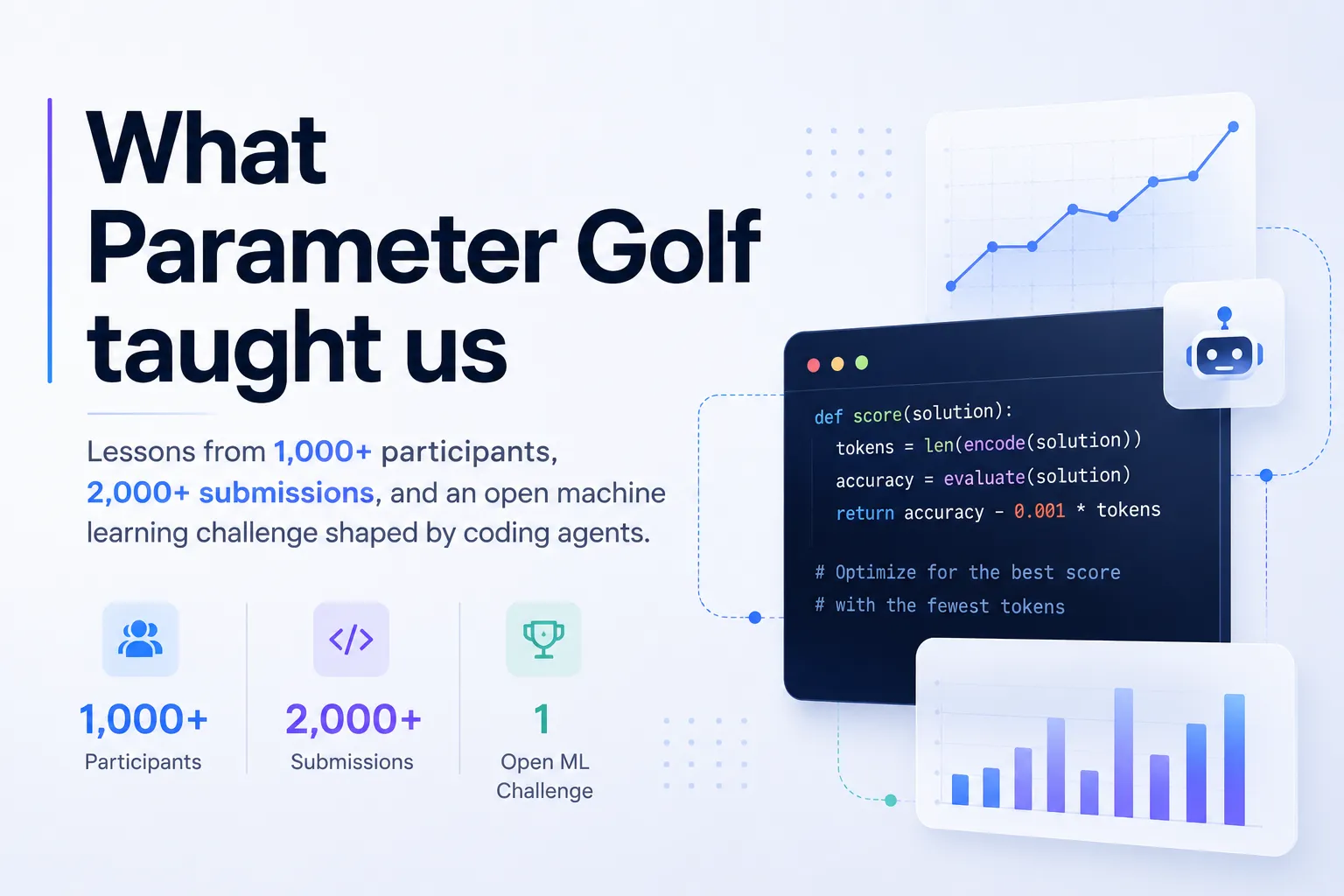
More than 1,000 participants submitted over 2,000 entries during the eight-week event. Teams experimented with tokenizer designs, quantization techniques, attention mechanisms, and training strategies to maximize performance within tight constraints.
One of the biggest lessons from the competition was that efficiency matters more than ever. Many participants achieved surprisingly strong results not by building larger models, but by making smarter engineering decisions. Small improvements in optimization, memory usage, and architecture design often produced major performance gains.
This reflects a growing shift in the AI industry. While large-scale models continue to dominate headlines, real-world applications depend heavily on efficiency. Companies deploying AI systems must consider cost, speed, energy usage, and hardware limitations. A smaller and more efficient model can sometimes be more practical than a larger one with marginally better performance.
Another important takeaway was the growing role of AI coding agents in research workflows. Many participants used AI tools to generate code, debug experiments, and accelerate development. Tasks that once required hours of manual work could now be completed much faster.
This dramatically increased the pace of experimentation. Researchers could test more ideas, iterate faster, and recover quickly from failed experiments. However, it also created challenges. Successful techniques spread rapidly throughout the competition as participants used AI systems to reproduce and modify strong approaches.
The event offered an early glimpse into the future of AI research, where humans increasingly focus on strategy while AI systems assist with execution.
Interestingly, the competition also encouraged creativity. Because participants could not rely on massive scale, many explored unconventional architectures and optimization methods. Some alternative approaches performed surprisingly well against traditional transformer-based models.
Ultimately, Parameter Golf demonstrated that the future of AI may not depend entirely on building larger systems. Innovation in efficiency, architecture, and optimization could become just as important as scale itself.
The competition showed that in AI, smarter solutions may matter just as much as bigger ones.