OpenAI's Secure Sandbox for Codex on Windows: Enabling Safe AI Coding
Quick Summary
- OpenAI has engineered a robust, secure sandbox for its Codex AI on Windows, allowing developers to leverage powerful coding agents without compromising system integrity.
- This innovative solution ensures untrusted code runs in a highly restricted environment, preventing unauthorized access and network misuse while maintaining efficiency.
OpenAI's Secure Sandbox for Codex on Windows: Enabling Safe AI Coding
The age of AI-powered coding is rapidly advancing, with tools like OpenAI's Codex transforming how developers write, debug, and understand software. However, integrating AI that generates or modifies code presents a unique security challenge: how do you run potentially untrusted, AI-generated instructions without risking system integrity? OpenAI has tackled this critical hurdle head-on, unveiling a sophisticated, secure sandbox specifically designed for Codex on Windows, paving the way for safer, more efficient AI coding agents. This groundbreaking development ensures that the power of AI assistance can be harnessed without compromising the underlying system.
The Engineering Behind Secure AI Code Execution
At its core, this significant update revolves around the implementation of a highly isolated execution environment for Codex. When an AI like Codex generates code or proposes a solution, running that code directly on a developer's machine could pose significant risks. Malicious code, even accidentally generated, could access sensitive files, exploit system vulnerabilities, or establish unwanted network connections. To mitigate these dangers, OpenAI engineered a "sandbox" – a tightly controlled virtual space where Codex-generated code can operate without affecting the host operating system.
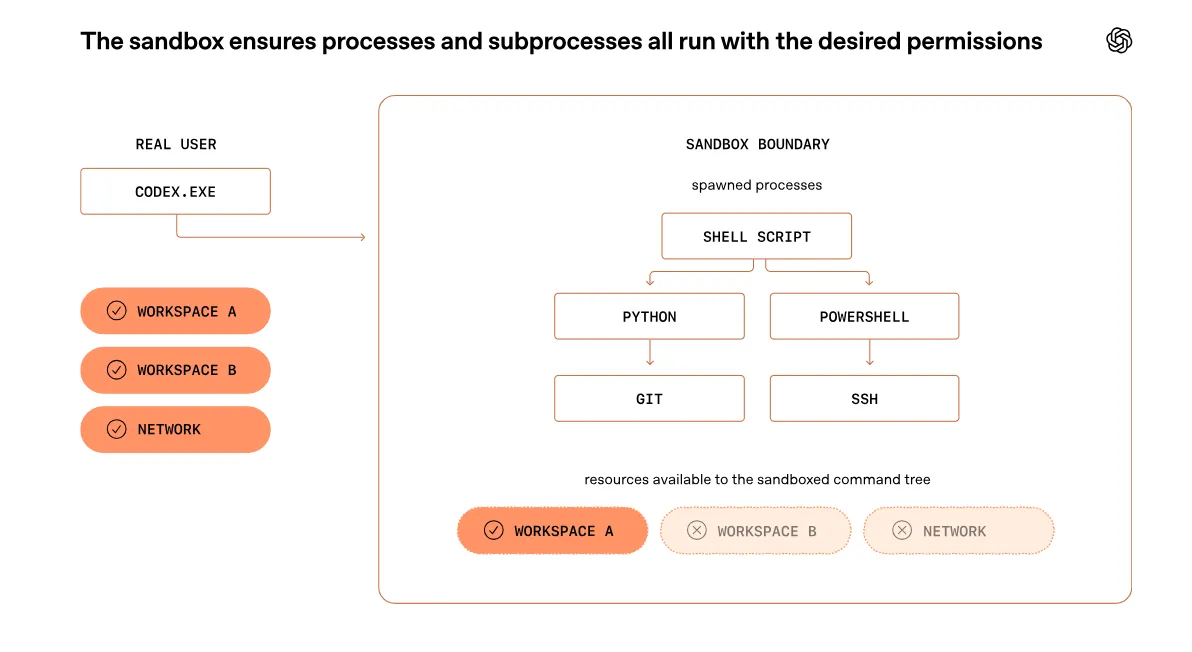
This sandbox operates on the principle of least privilege, severely limiting what the executing code can do. Instead of running directly on the Windows environment with full permissions, the code is confined to a dedicated process with stringent restrictions. These restrictions include:
- Strict File System Isolation: The sandbox provides a highly curated view of the file system. Codex-generated code is limited to specific, pre-approved directories, often in a read-only capacity. Any attempts to access critical system files, user documents, or network shares are blocked outright, preventing data exfiltration or system damage.
- Network Activity Control: Outgoing network connections are severely curtailed, if not entirely blocked. This prevents AI agents from communicating with external servers, which could be used for data theft, command-and-control, or spreading malware. Where network access is absolutely necessary (e.g., to fetch libraries), it is strictly whitelisted and monitored.
- Resource Management: The sandbox also governs resource consumption, such as CPU cycles and memory usage. This prevents runaway processes from monopolizing system resources, ensuring stability and responsiveness for the user.
Leveraging Windows' robust security features, the implementation likely integrates process isolation capabilities or containerization approaches to create lightweight, yet powerful, virtual environments. The goal is to create a secure perimeter around the AI's execution, turning potential risks into contained operations.
Key Highlights and Features
- Unparalleled Code Execution Security: Isolates AI-generated code from the host operating system, preventing unauthorized access or malicious actions.
- Granular File System Control: Restricts file access to a meticulously whitelisted, often read-only, set of directories, protecting sensitive user data and system files.
- Robust Network Restrictions: Limits or completely blocks outbound network connections from the sandboxed environment, thwarting data exfiltration and external communication.
- Efficient Resource Governance: Manages CPU and memory allocation for AI-generated code, ensuring system stability and preventing resource exhaustion.
- Streamlined Developer Experience: Enables developers to confidently utilize powerful AI coding assistance without constantly worrying about underlying security risks.
- Foundation for Trustworthy AI Agents: Establishes a precedent for integrating advanced AI into critical development workflows in a secure and responsible manner.
Why This Matters: Impact and Implications
This secure sandbox represents a pivotal step forward for several reasons. Firstly, it dramatically enhances developer productivity and trust. Developers can now experiment with and deploy AI-generated code snippets, refactorings, or even entire functions with a significantly reduced risk profile. This confidence is crucial for widespread adoption, moving AI assistants beyond suggestions to active participants in the development lifecycle.
Secondly, it fosters innovation in AI agent development. By providing a safe environment, researchers and engineers can now build more sophisticated and autonomous AI coding agents that can test their own code, fix bugs, and even interact with mock environments, all within a secure perimeter. This opens doors for AI systems to move from passive assistants to active problem-solvers.
Furthermore, this move sets a critical security precedent for the integration of powerful AI into user-facing applications. As AI capabilities grow, the potential for unintended consequences or malicious misuse also escalates. OpenAI's commitment to building secure execution environments demonstrates a responsible approach to AI deployment, emphasizing safety alongside utility. This builds trust in advanced AI technologies.
Finally, for real-world applications, this means AI can be more deeply embedded in crucial development tasks. Imagine an AI debugging tool that can safely run potentially flawed code, identify issues, and even propose fixes without endangering the developer's workstation. Or an AI that can generate and test unit tests, verifying code integrity in a contained, controlled space. These applications become viable and practical thanks to robust sandboxing.
Conclusion and Future Impact
OpenAI's secure sandbox for Codex on Windows is more than just a technical update; it's a foundational advancement for the responsible integration of AI into software development. By meticulously controlling the environment in which AI-generated code operates, OpenAI has significantly lowered the barrier to adopting advanced coding agents, making them both powerful and trustworthy.
Looking ahead, this development will likely inspire similar security measures across the AI landscape. As AI models become even more capable and autonomous, the emphasis on robust, transparent, and secure execution environments will only grow. This innovation not only protects developers today but also lays the groundwork for a future where AI and human ingenuity can collaborate seamlessly and securely, pushing the boundaries of what's possible in software engineering without compromising safety. The continued evolution of such sandboxing technologies will be vital in ensuring that AI serves as a powerful, beneficial, and secure partner in our technological journey.