Virgin Atlantic Revolutionizes App Delivery with OpenAI's Codex
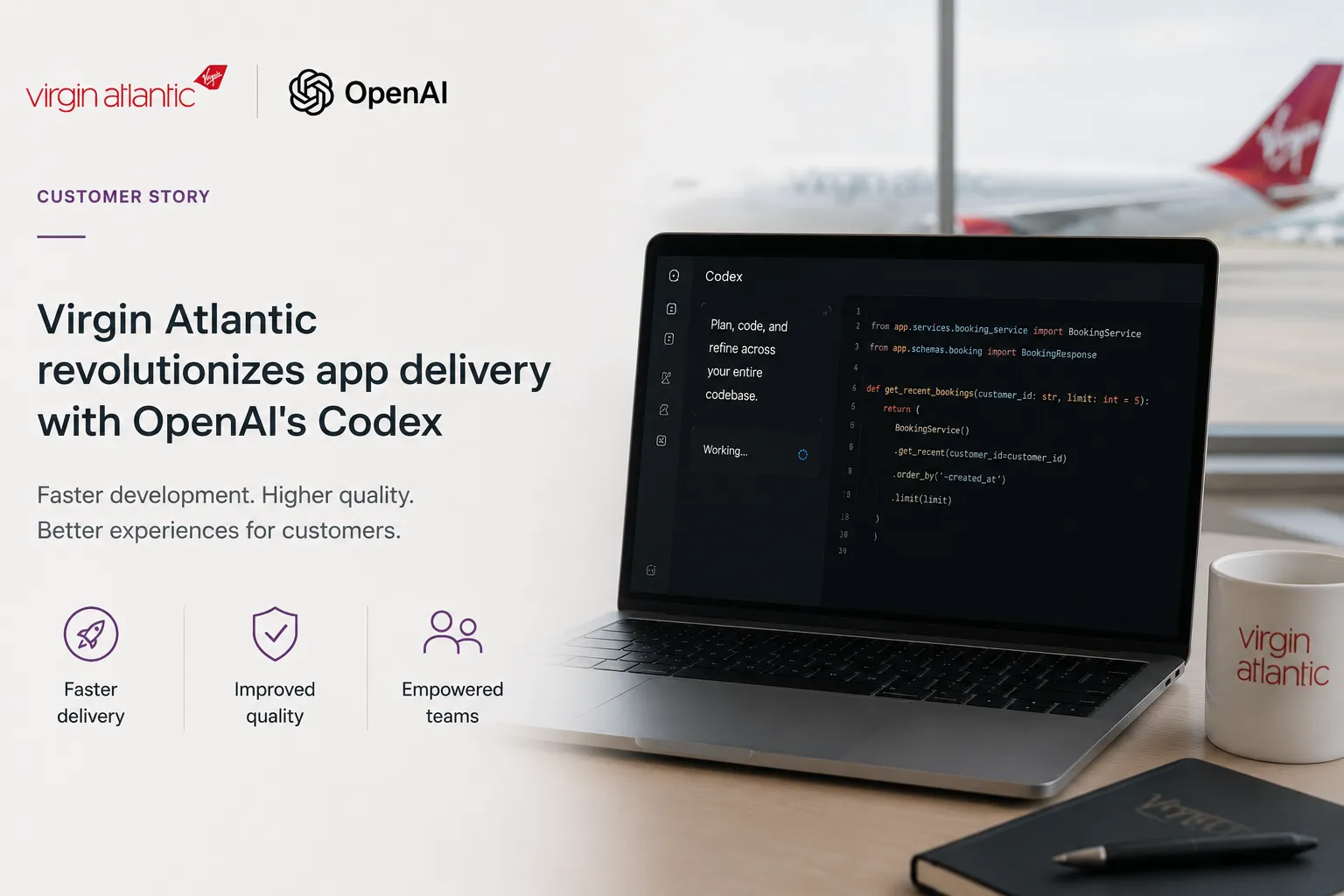
Quick Summary
- Virgin Atlantic successfully leveraged OpenAI's Codex to accelerate the development of its revamped mobile app, meeting a critical holiday travel deadline.
- This innovative approach resulted in near-total unit test coverage and zero P1 defects, setting a new benchmark for AI-powered software development efficiency and quality.
Virgin Atlantic Revolutionizes App Delivery with OpenAI's Codex
In the ever-evolving landscape of digital transformation, the pressure to deliver high-quality software rapidly is immense. Airlines, in particular, face unique challenges, with millions of passengers relying on their digital platforms for critical travel information and services. Virgin Atlantic recently navigated these turbulent waters with remarkable success, utilizing OpenAI's sophisticated AI coding assistant, Codex, to revamp its mobile application under a stringent holiday travel deadline.
AI-Powered Acceleration for a Critical Mobile App Revamp
Virgin Atlantic embarked on an ambitious project to overhaul its mobile application, a vital touchpoint for its global customer base. The revamp aimed to enhance user experience, introduce new features, and streamline essential functionalities, all while ensuring robust performance during the peak holiday travel season. This meant the project wasn't just about innovation; it was about flawless execution under intense time pressure.
The airline turned to OpenAI's Codex, an advanced AI system capable of translating natural language into code, generating code from prompts, and assisting developers in various programming tasks. By integrating Codex into their development workflow, Virgin Atlantic's engineering teams could significantly accelerate multiple stages of the software development lifecycle. Codex acted as an intelligent co-pilot, helping developers write code more efficiently, automating repetitive tasks, and even suggesting optimal solutions to complex programming challenges. This augmentation allowed the team to focus more on architectural design and critical business logic, rather than getting bogged down in boilerplate code or syntax.
Key Highlights and Breakthroughs
The adoption of Codex yielded tangible and impressive results for Virgin Atlantic, setting new standards for project delivery:
- Rapid Development Cycle: Despite the ambitious scope and fixed holiday travel deadline, the team successfully launched the revamped mobile app on schedule. Codex played a crucial role in speeding up coding, debugging, and integration processes, ensuring swift progress.
- Near-Total Unit Test Coverage: Achieving high unit test coverage is a hallmark of robust and maintainable software. With Codex's assistance, Virgin Atlantic reached near-total unit test coverage, a significant feat that ensures comprehensive validation of individual code components. This dramatically reduces the likelihood of bugs making it into production.
- Zero P1 Defects: Perhaps the most critical achievement was the deployment of the app with zero P1 (Priority 1) defects. P1 defects are critical bugs that severely impact core functionality and user experience. Eliminating these entirely for a high-traffic app, especially during a peak travel period, speaks volumes about the quality assurance facilitated by AI-driven development and testing.
- Enhanced Developer Productivity: By offloading repetitive coding tasks and providing instant code suggestions, Codex empowered Virgin Atlantic's developers to be more productive, allowing them to allocate their expertise to more complex problem-solving and innovative feature development.
Why This Matters: Impact Analysis
Virgin Atlantic's success with Codex is more than just a single project triumph; it represents a significant milestone in the broader application of AI in software engineering. The implications are far-reaching:
- For Virgin Atlantic: The airline solidified its reputation for digital innovation and customer-centricity. A highly reliable and feature-rich app during the holiday season translated directly into improved customer satisfaction, reduced support calls, and a seamless travel experience for millions. This also translates to operational efficiencies and a stronger competitive edge.
- For the Software Industry: This case study provides compelling evidence of how AI coding assistants can transform development workflows, offering a glimpse into a future where AI and human developers collaborate seamlessly. It demonstrates that AI isn't just a tool for research but a practical, production-ready solution for enterprise-level challenges.
- For Users: Ultimately, the beneficiaries are the end-users. More reliable, bug-free applications developed faster mean a better digital experience across various services, reducing frustration and enhancing overall engagement.
Conclusion and Future Implications
Virgin Atlantic's successful integration of OpenAI's Codex into its mobile app development marks a pivotal moment, showcasing the immense potential of artificial intelligence to revolutionize how software is built. By meeting a demanding deadline with an application boasting near-total unit test coverage and zero critical defects, the airline has set a new benchmark for quality and efficiency in the digital age.
As AI technologies continue to advance, we can expect to see even deeper integration into every facet of the software development lifecycle. This paradigm shift suggests a future where developers are augmented by powerful AI assistants, enabling them to innovate faster, deliver higher quality products, and focus on the creative, strategic aspects of their work. Virgin Atlantic's journey with Codex is a powerful testament to this future, proving that the skies for AI-powered development are truly open.