PaddleOCR 3.5 Unleashes Transformer Power for Advanced OCR & Document Parsing
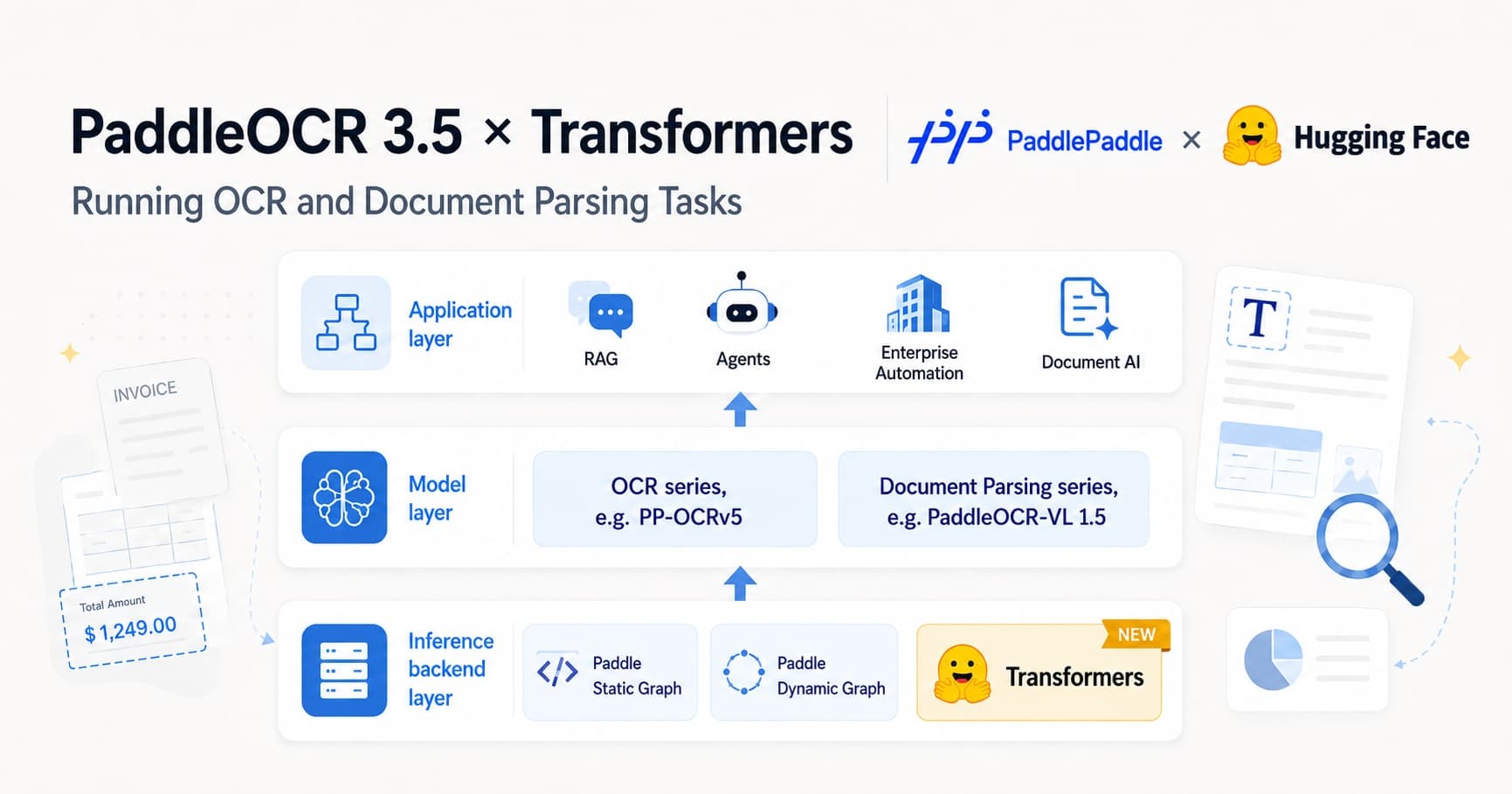
Quick Summary
- PaddleOCR 3.5 marks a significant leap in AI-powered document processing, integrating a robust Transformers backend for enhanced OCR and complex document parsing tasks like table recognition and key information extraction.
- This update promises improved accuracy, deeper contextual understanding, and broad accessibility for developers and businesses.
The complexity of converting unstructured document images into usable, structured data has long been a bottleneck for businesses and developers alike. Optical Character Recognition (OCR) has evolved significantly, but true document understanding—parsing intricate layouts, extracting precise key information, and accurately recognizing tables—remains a formidable challenge. Enter PaddleOCR 3.5, a groundbreaking update that promises to revolutionize this field by integrating a robust Transformers backend, marking a significant leap forward in AI-powered document processing.
Main Update: The Power of Transformers in Document Understanding
The core innovation in PaddleOCR 3.5 lies in its adoption of a sophisticated Transformers architecture. Traditionally, OCR systems have relied on convolutional neural networks (CNNs) for image feature extraction and recurrent neural networks (RNNs) for sequence modeling of text. While effective, these models sometimes struggle with the complex spatial relationships and long-range dependencies inherent in densely structured documents. Transformers, initially popularized in natural language processing for their ability to model distant dependencies and parallelize computations, are now proving equally transformative in computer vision tasks.
By leveraging a Transformers backend, PaddleOCR 3.5 can better grasp the holistic context of a document. This means improved accuracy not just in recognizing individual characters or words, but in understanding their arrangement, identifying distinct regions (like paragraphs, headings, lists), accurately parsing tables, and extracting key-value pairs even when layouts are inconsistent. This architectural shift enables the model to process document images with a deeper, more contextual understanding, leading to superior performance in complex document parsing tasks, significantly reducing errors and improving data integrity.
Key Highlights and Features of PaddleOCR 3.5
PaddleOCR 3.5 brings a suite of enhancements designed to push the boundaries of document automation:
- State-of-the-Art Transformers Backend: At its heart, PaddleOCR 3.5 now fully leverages Transformer models for enhanced text recognition and sophisticated document layout analysis. This results in significantly improved accuracy and robustness across diverse document types and challenging visual conditions, from scanned invoices to complex scientific papers.
- Advanced Document Parsing Capabilities: Beyond simple text extraction, the update excels at intricate document parsing. This includes highly accurate table recognition (identifying rows, columns, and cell contents), robust layout analysis to identify different semantic regions (e.g., text blocks, images, forms), and sophisticated key information extraction (KIE) for structured data retrieval from semi-structured documents (e.g., automatically pulling invoice numbers, dates, and totals).
- Multi-Language and Diverse Script Support: Building on PaddleOCR's strong foundation, version 3.5 continues to offer extensive support for a wide array of languages and scripts, making it a versatile tool for global applications and multilingual document processing needs.
- Optimized Performance and Ease of Use: Developed by Baidu and readily available on Hugging Face, PaddleOCR 3.5 is designed for both high performance and user-friendliness. Its optimized models and comprehensive documentation facilitate easier integration and deployment for developers, allowing them to quickly implement advanced OCR solutions.
- Open-Source Accessibility: As an open-source project, PaddleOCR 3.5 ensures that these cutting-edge capabilities are accessible to a broad community of researchers, developers, and businesses, fostering further innovation and application across various industries.
Why This Matters: Impact Analysis
The implications of PaddleOCR 3.5 are far-reaching. For businesses, it translates into unprecedented levels of automation for data entry, document processing, and information retrieval. Industries like finance, legal, healthcare, and logistics, which handle vast volumes of documents, can significantly reduce manual effort, minimize human error, and accelerate workflows. Imagine automatically extracting precise figures from thousands of invoices or contracts in minutes, rather than hours or days, leading to substantial cost savings and improved operational efficiency.
For developers and AI practitioners, PaddleOCR 3.5 provides a powerful, open-source toolkit to build more intelligent applications that can truly "read" and comprehend documents. It democratizes access to advanced Transformer-based architectures for document understanding, previously a complex and resource-intensive domain. Furthermore, this release underscores the growing trend of leveraging Transformer models beyond natural language processing, pushing the boundaries of what's possible in computer vision and multimodal AI.
Conclusion and Future Impact
PaddleOCR 3.5 represents a pivotal moment in the evolution of Optical Character Recognition and document understanding. By integrating a cutting-edge Transformers backend, it addresses long-standing challenges in accuracy, contextual understanding, and structural parsing of complex documents. This release not only empowers current applications with superior performance but also lays a robust foundation for future innovations.
We can anticipate more sophisticated AI assistants capable of summarizing entire reports, intelligent automation platforms that can manage entire document lifecycles from ingestion to archival, and even more seamless human-computer interaction with both digital and physical text alike. PaddleOCR 3.5 is not just an update; it's a testament to the accelerating pace of AI research and its practical application, bringing us closer to a world where every document can truly speak its data and contribute meaningfully to the digital economy.