Revolutionizing Sales: How OpenAI Codex Transforms Workflows with AI
Quick Summary
- OpenAI's Codex is empowering sales teams to automate and enhance critical administrative tasks.
- By leveraging AI, sales professionals can generate insightful documents like pipeline briefs and account plans, freeing them to focus on strategic selling and client relationships.
Revolutionizing Sales: How OpenAI Codex Transforms Workflows with AI
In the fast-paced world of sales, efficiency and strategic insight are paramount. Sales teams are constantly challenged to manage vast amounts of data, prepare for critical meetings, and craft compelling strategies, often at the expense of time spent actively engaging with clients. The promise of Artificial Intelligence (AI) to streamline these processes has long been a topic of discussion, and now, with advancements like OpenAI's Codex, that promise is becoming a tangible reality for sales organizations worldwide.
OpenAI Codex: A New Era for Sales Productivity
OpenAI's Codex, originally renowned for its prowess in generating code from natural language, is now demonstrating profound applicability in the sales domain. This powerful AI model is being leveraged to automate and intelligentize the creation of essential sales documentation and analysis. By processing 'real work inputs' – everything from CRM data and email communications to call transcripts and historical performance metrics – Codex can synthesize complex information into actionable, ready-to-use formats. This capability marks a significant shift, moving sales professionals away from manual data compilation towards a more strategic, AI-augmented approach.
Key AI-Powered Sales Applications with Codex
Codex's ability to interpret and generate human-like text from diverse data sources translates into several high-impact applications for sales teams:
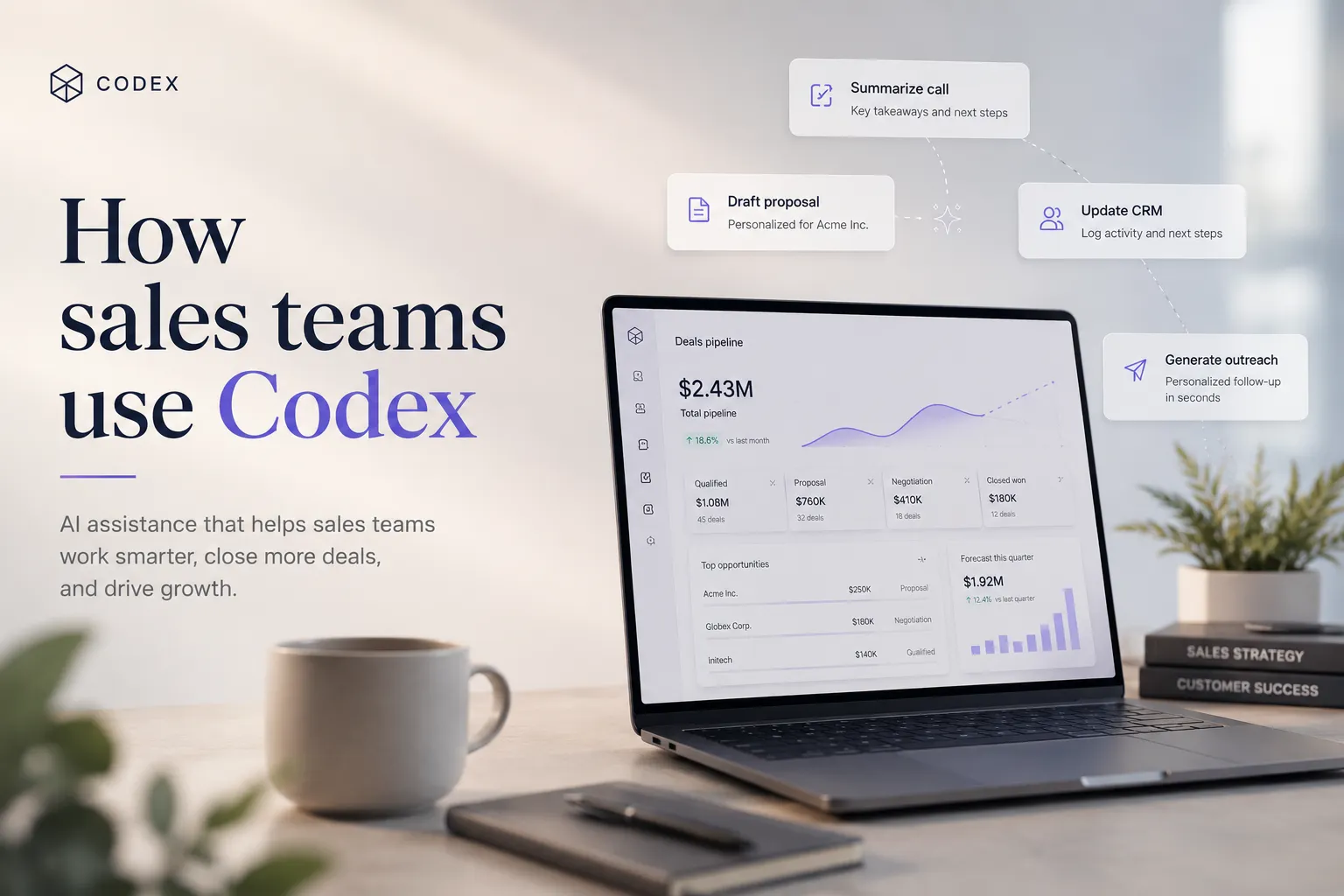
- Pipeline Briefs: Codex can analyze extensive CRM pipeline data – including deal stages, values, close probabilities, and associated notes – to generate concise, actionable pipeline briefs. These summaries highlight key risks, opportunities, and next steps, providing sales managers and reps with an instant overview of their sales funnel. The input could be daily CRM activity logs, sales rep comments, and historical win/loss data.
- Meeting Prep Packets: Before crucial client meetings, Codex can compile comprehensive preparation packets. This involves aggregating client history, recent interaction summaries, key objectives, and even potential talking points. Inputs might include email threads, call recordings/transcripts, previous meeting minutes, and account activity logs, ensuring reps are thoroughly briefed without manual data digging.
- Forecast Reviews: Automating the generation of forecast reviews, Codex can analyze current pipeline data, historical sales trends, and market indicators to provide detailed predictive insights. It can highlight variances, identify key contributing factors to performance, and offer data-driven recommendations, helping leadership make more informed decisions during review sessions.
- Account Plans: Building strategic account plans becomes significantly faster and more thorough. Codex can process extensive customer history, product usage data, engagement metrics, and even relevant company news to help construct tailored account plans. These plans can identify strategic goals, key stakeholders, cross-sell/upsell opportunities, and potential competitive threats.
- Stalled-Deal Diagnoses: One of the most challenging aspects of sales is identifying why deals stall. Codex can analyze the timeline of interactions, specific objections raised in communication logs, changes in deal status, and comparisons to similar successful/stalled deals to pinpoint root causes. It can then suggest actionable revival strategies, such as re-engagement tactics or necessary escalations.
Why This Matters: The Impact on Sales Performance
The integration of OpenAI Codex into sales workflows represents a significant leap forward for several reasons:
- Increased Productivity: By automating time-consuming administrative tasks, sales professionals are freed up to focus on core selling activities, customer engagement, and strategic thinking. This directly translates to more time spent building relationships and closing deals.
- Enhanced Decision-Making: Rapid access to AI-generated, data-driven insights ensures that sales strategies are informed, precise, and timely. Better data means better decisions, from individual deal pursuit to overall pipeline management.
- Improved Sales Performance: With comprehensive preparation, deeper insights into stalled deals, and clearer pipeline visibility, sales teams are better equipped to navigate challenges, capitalize on opportunities, and ultimately boost their win rates and revenue generation.
- Scalability and Consistency: AI-driven document generation ensures a consistent quality and format across all team members, making onboarding new reps easier and standardizing best practices across the organization.
- Competitive Advantage: Organizations leveraging AI for such critical functions will gain a significant competitive edge, reacting faster to market changes and client needs than those relying on manual processes.
Conclusion: The Future of Sales is Collaborative AI
The application of OpenAI Codex in sales is more than just a technological upgrade; it's a fundamental shift in how sales teams operate. By offloading the arduous tasks of data aggregation and document generation to AI, sales professionals can reclaim their most valuable asset: time. This allows them to dedicate more energy to the human elements of selling—building rapport, understanding complex needs, and crafting bespoke solutions. As AI models continue to evolve, we can anticipate even more sophisticated assistance, from hyper-personalized communication suggestions to predictive analytics that anticipate customer needs. The future of sales will increasingly be a collaborative endeavor between human expertise and powerful AI tools, leading to unprecedented levels of efficiency, insight, and success.