NVIDIA Supercharges AI Development with OpenAI Codex and Advanced GPT Models
Quick Summary
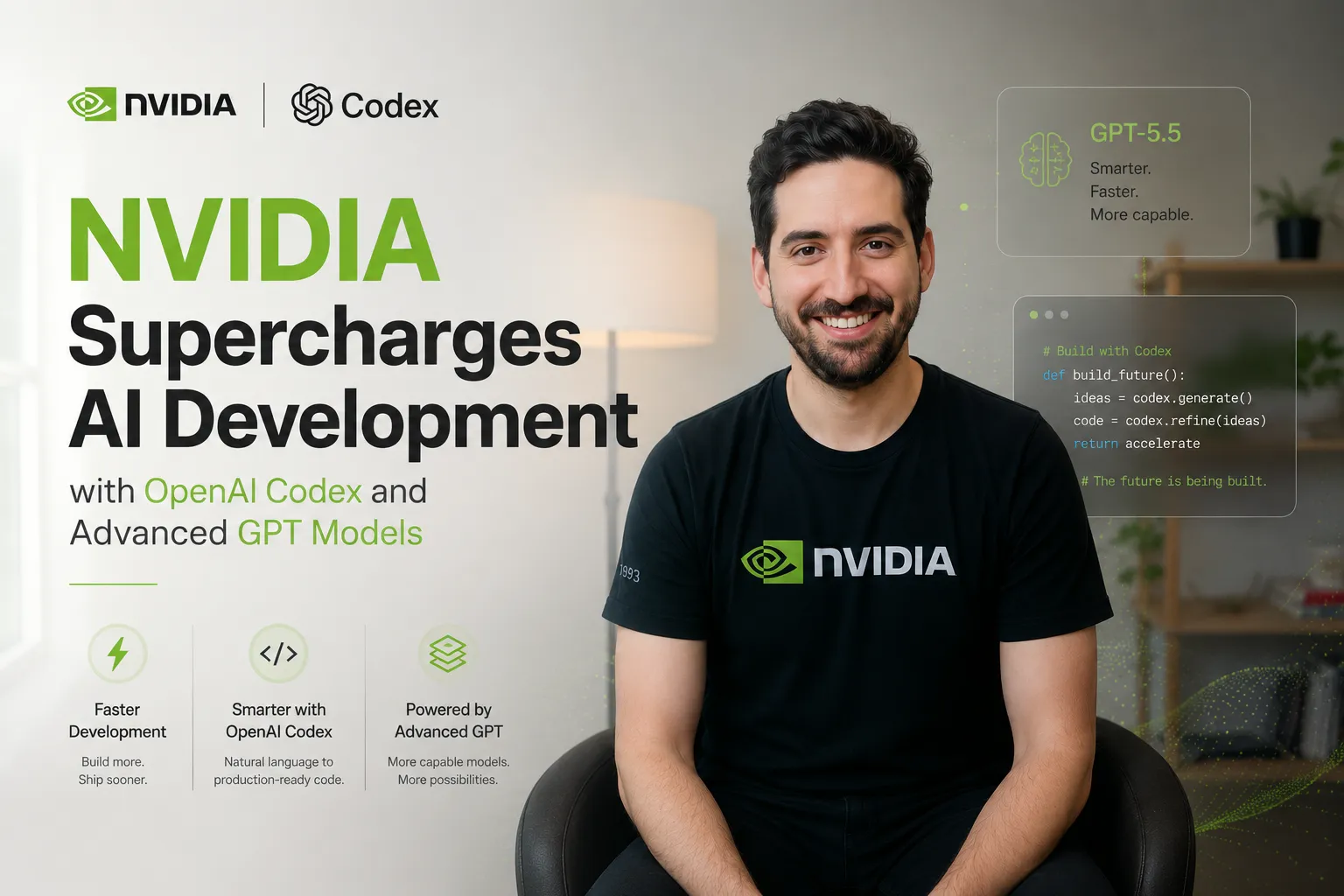
- NVIDIA's engineering and research teams are leveraging OpenAI's Codex, powered by advanced GPT-5.5 models, to dramatically accelerate their AI development workflows.
- This integration allows them to rapidly move from conceptual research ideas to functional experiments and efficiently ship production-ready AI systems, boosting productivity and innovation.
NVIDIA Supercharges AI Development with OpenAI Codex and Advanced GPT Models
In the rapidly evolving landscape of artificial intelligence, speed and innovation are paramount. NVIDIA, a company synonymous with cutting-edge AI hardware and software, is constantly pushing the boundaries of what's possible. A key strategy for maintaining this leadership involves adopting advanced AI tools for their own development processes. Recent insights reveal that NVIDIA's formidable teams of engineers and researchers are now leveraging OpenAI's sophisticated Codex, enhanced by advanced GPT-5.5 models, to revolutionize their development workflows, accelerating both research and production system deployment.
The Synergy: Codex, GPT-5.5, and NVIDIA's AI Prowess
OpenAI Codex, the AI model behind GitHub Copilot, is renowned for its ability to translate natural language into code and assist with various programming tasks. When combined with what is referred to as "GPT-5.5" – an advanced iteration of OpenAI's powerful Generative Pre-trained Transformers – its capabilities reach new heights. For NVIDIA's development teams, this synergy means an unprecedented level of AI-assisted programming that streamlines complex tasks, reduces manual coding, and frees up human talent to focus on higher-level architectural and conceptual challenges.
This integration isn't just about faster typing; it's about intelligent code generation, error detection, refactoring suggestions, and even the ability to quickly prototype experimental setups from abstract ideas. Whether it's developing intricate CUDA kernels, building advanced deep learning frameworks, or designing autonomous systems, the combination of Codex and GPT-5.5 acts as an indispensable co-pilot, enhancing the entire software development lifecycle at NVIDIA.
Key Highlights of NVIDIA's AI-Assisted Development
NVIDIA's adoption of Codex with advanced GPT models is yielding significant benefits, transforming how their teams approach both research and product development:
- Accelerated Prototyping and Experimentation: Research ideas that once required extensive manual coding to set up can now be translated into runnable experiments with remarkable speed. This allows researchers to validate hypotheses, iterate faster, and explore more avenues of innovation in less time.
- Enhanced Engineer Productivity: By automating boilerplate code, suggesting optimal solutions, and assisting with debugging, Codex significantly reduces the time engineers spend on repetitive or less complex coding tasks. This boosts overall efficiency and allows teams to tackle more ambitious projects.
- Faster Time-to-Market for Production Systems: The efficiency gains directly translate into quicker development cycles for NVIDIA's production-ready AI systems. From foundational AI software to new features in their platforms, the ability to ship high-quality code faster provides a crucial competitive edge.
- Improved Code Quality and Consistency: AI-generated suggestions often adhere to best practices and coding standards, which can lead to more robust, maintainable, and consistent codebases across different projects and teams.
- Democratization of Complex Tasks: Codex can help bridge knowledge gaps, making it easier for engineers to work with unfamiliar libraries or complex frameworks by providing context-aware code suggestions and explanations.
Why This Matters: Impact on the AI Industry and Beyond
NVIDIA's strategic integration of OpenAI Codex and advanced GPT models is more than just an internal efficiency upgrade; it signals a profound shift in how leading technology companies approach software development and innovation.
Firstly, it solidifies the role of AI as a co-creator, not just a tool. This human-AI collaboration paradigm is set to become the standard, enabling developers to scale their capabilities and tackle problems of unprecedented complexity. For NVIDIA, this means an accelerated pace of innovation in areas critical to AI's future, such as high-performance computing, generative AI, robotics, and autonomous vehicles.
Secondly, it highlights the potential for a virtuous cycle where AI is used to build more advanced AI. As NVIDIA develops more sophisticated AI hardware and software, using AI-assisted tools like Codex ensures that the development process itself remains at the forefront of efficiency and capability. This approach is vital for maintaining their dominant position in the fiercely competitive AI market.
Finally, the success of such deployments at a company like NVIDIA provides a powerful testament to the transformative potential of large language models in enterprise settings. It sets a precedent for other industries to explore how AI-powered coding assistants can unlock new levels of productivity and drive innovation across various domains.
Conclusion: The Future is AI-Assisted
NVIDIA's adoption of OpenAI Codex with advanced GPT-5.5 models marks a significant milestone in the evolution of software engineering. By empowering their engineers and researchers with sophisticated AI assistants, NVIDIA is not only streamlining its internal processes but also accelerating the very pace of AI innovation itself. This synergy underscores a future where human ingenuity, augmented by powerful AI, can transcend current limitations, turning audacious research ideas into reality and delivering production systems faster than ever before. As AI continues to build upon itself, the possibilities for technological advancement become truly limitless.