Hugging Face Integrates Nunchaku 4-bit Diffusion: A Leap in Efficient AI Generation
Quick Summary
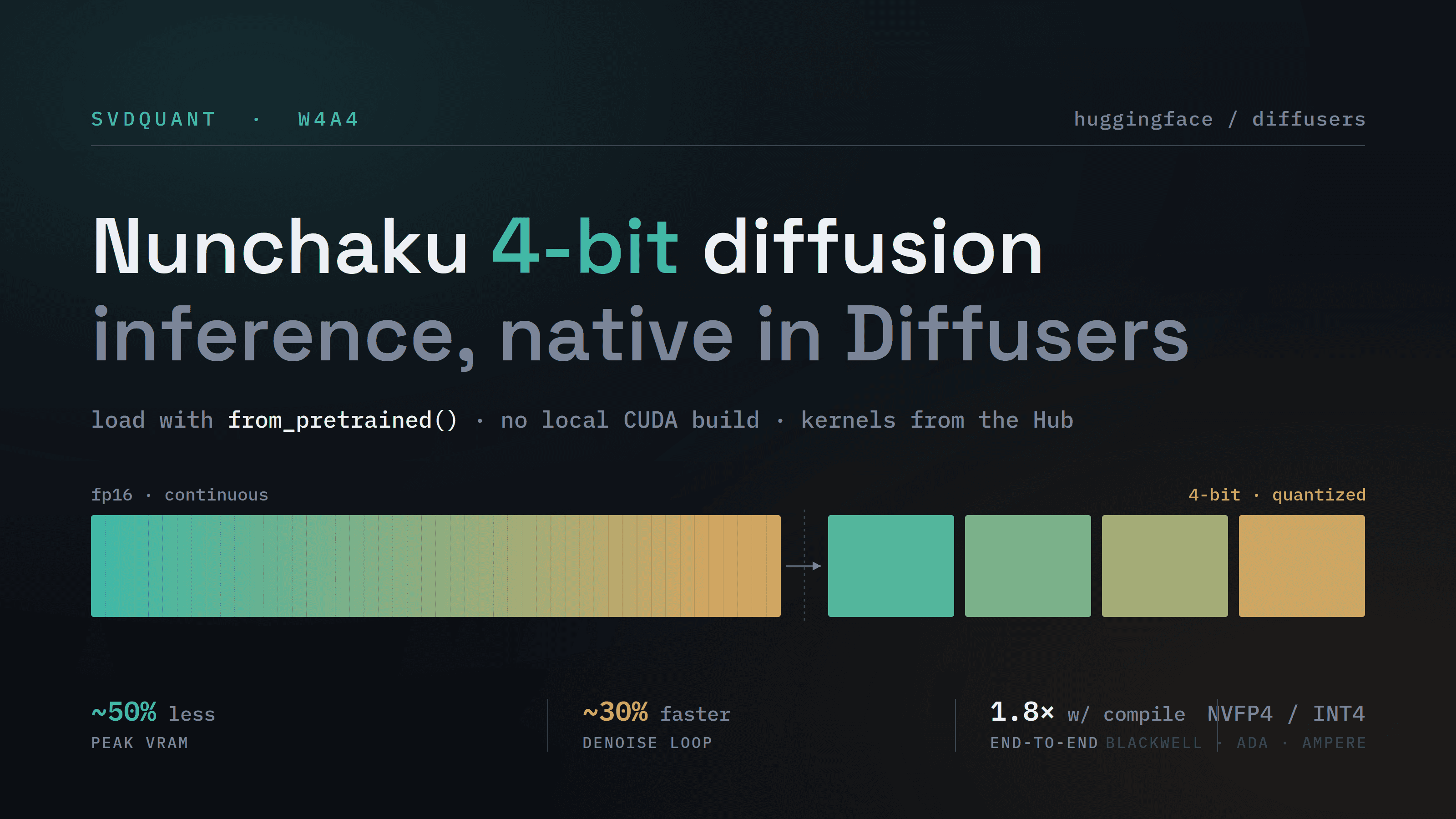
- Hugging Face's `diffusers` library now supports Nunchaku 4-bit diffusion inference, significantly boosting the efficiency and accessibility of generative AI models.
- This integration promises faster image generation and reduced memory footprint, making advanced AI art creation more widely available.
Hugging Face Integrates Nunchaku 4-bit Diffusion: A Leap in Efficient AI Generation
Generative Artificial Intelligence, particularly diffusion models, has revolutionized creative industries, enabling the on-demand creation of stunning images, art, and designs. However, the immense computational resources required for these models have often been a bottleneck, limiting their accessibility and real-world deployment. Today, Hugging Face addresses this challenge head-on by integrating the groundbreaking Nunchaku 4-bit diffusion inference technique directly into its widely used diffusers library, marking a pivotal moment for efficiency in AI generation.
Unpacking Nunchaku 4-bit Diffusion in Diffusers
The core of this exciting update lies in Nunchaku, a novel method for quantizing diffusion models to a highly efficient 4-bit precision. In simple terms, quantization reduces the precision of the numerical values (weights and activations) within a neural network. While most models traditionally operate at 16-bit or 32-bit precision, Nunchaku's 4-bit quantization dramatically slashes the memory footprint and computational requirements without significantly compromising the quality of the generated output. This allows models to run much faster and on hardware with far fewer resources.
Hugging Face's diffusers library has become the de facto standard for working with diffusion models, offering a user-friendly and modular interface for everything from Stable Diffusion to latent diffusion models. By embedding Nunchaku 4-bit inference directly into diffusers, Hugging Face empowers developers, researchers, and creators to effortlessly leverage these optimizations. This means that instead of requiring specialized setups or complex modifications, users can now achieve significant performance gains with minimal changes to their existing diffusers workflows.
Key Highlights and Features
The integration of Nunchaku 4-bit diffusion brings several compelling advantages:
- Substantial Speedup: Users can expect a dramatic increase in inference speed, translating to faster image generation times and quicker iteration cycles for creative projects or research experiments. While exact percentages vary by model and hardware, the performance boost is universally noticeable.
- Reduced Memory Footprint: By storing model weights at 4-bit precision, the memory requirements (particularly VRAM on GPUs) are drastically lowered. This enables running larger, more complex diffusion models on less powerful GPUs or even consumer-grade hardware, previously deemed insufficient.
- Enhanced Accessibility: The lower resource demands democratize access to state-of-the-art generative AI. More individuals and organizations can now experiment with and deploy diffusion models locally, reducing reliance on expensive cloud computing services.
- Seamless Integration: The Nunchaku optimizations are designed to work harmoniously within the
diffusersframework, ensuring a smooth transition for current users and a simplified entry point for newcomers. This 'plug-and-play' approach accelerates development and deployment. - Energy Efficiency: Faster computation and reduced memory usage inherently lead to lower energy consumption per generation, contributing to more sustainable AI development and deployment.
Why This Matters: Impact Analysis
This update is more than just a technical improvement; it represents a significant leap forward for the entire generative AI ecosystem:
- For Developers and Researchers: The ability to iterate faster and run more experiments on readily available hardware will accelerate innovation in diffusion model research and application development. It also significantly lowers infrastructure costs for businesses relying on generative AI.
- For Artists and Creators: Imagine generating high-resolution images or animations in seconds on your personal computer, without the need for high-end workstations or expensive cloud subscriptions. This empowers artists with greater creative freedom, privacy, and control over their AI-driven workflows.
- Democratization of AI: By lowering the barrier to entry, Nunchaku 4-bit diffusion makes advanced generative AI accessible to a broader audience, fostering diverse applications and driving widespread adoption across various industries, from marketing and design to gaming and education.
- Edge Computing Potential: The dramatically reduced resource demands open new possibilities for deploying diffusion models on edge devices, enabling real-time generation in scenarios like mobile applications or embedded systems.
Conclusion and Future Impact
Hugging Face's integration of Nunchaku 4-bit diffusion into the diffusers library is a testament to the ongoing advancements in AI optimization. It addresses a critical bottleneck—resource intensity—making powerful generative AI models faster, cheaper, and more accessible than ever before. This move is poised to unlock new creative avenues, accelerate research, and drive the mainstream adoption of diffusion models across diverse applications.
As AI continues to evolve, techniques like Nunchaku will be crucial in balancing performance with efficiency, ensuring that the incredible capabilities of generative AI are not confined to specialized labs but are available to innovators and creators worldwide. This marks a clear step towards a future where sophisticated AI models are not just powerful, but also practical and pervasive.