NVIDIA NeMo AutoModel: Revolutionizing Transformer Fine-Tuning for AI Development
Quick Summary
- NVIDIA NeMo AutoModel is transforming how developers fine-tune large language models and transformer architectures.
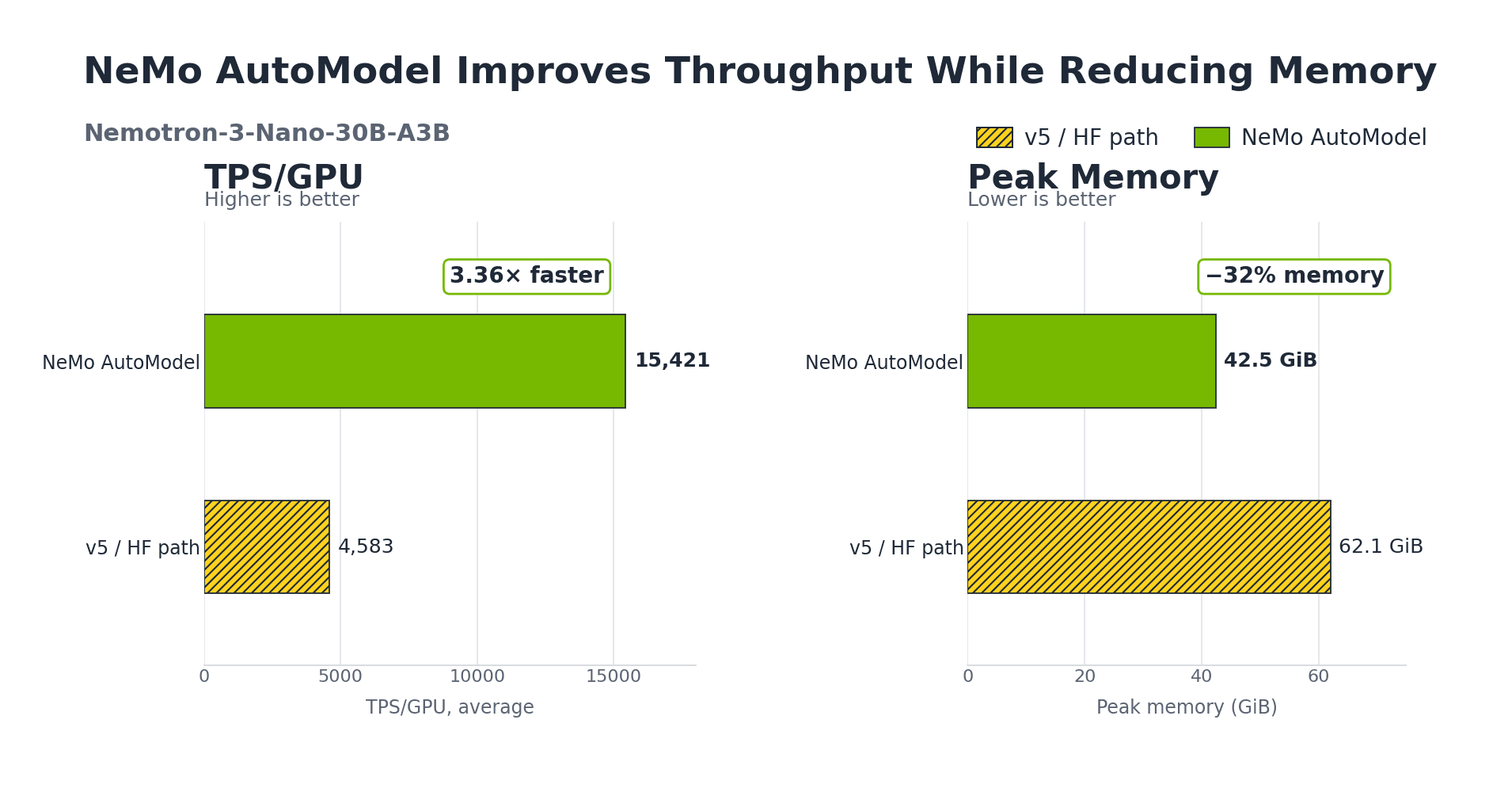
- By automating complex processes and leveraging NVIDIA's accelerated computing, it dramatically speeds up model customization, making advanced AI more accessible and efficient for a wider range of applications.
NVIDIA NeMo AutoModel: Revolutionizing Transformer Fine-Tuning for AI Development
The landscape of artificial intelligence is rapidly evolving, with transformer models and Large Language Models (LLMs) at the forefront of innovation. However, the path from a pre-trained powerhouse to a specialized solution often involves a complex, resource-intensive process known as fine-tuning. This critical step, which adapts a general model to specific tasks or datasets, has traditionally been a bottleneck for many developers and organizations. Enter NVIDIA NeMo AutoModel – a groundbreaking solution designed to dramatically accelerate and simplify transformer fine-tuning, pushing the boundaries of what's possible in AI development.
Unlocking Efficiency: The NeMo AutoModel Advantage
NVIDIA NeMo AutoModel represents a significant leap forward in making state-of-the-art AI accessible and deployable. At its core, NeMo AutoModel is built to streamline the intricate process of fine-tuning transformer models, from data preparation to hyperparameter optimization. It intelligently automates many of the manual, trial-and-error steps that typically consume valuable time and computational resources, thereby empowering developers to achieve optimal model performance with unprecedented speed and ease. Drawing inspiration from and often integrating seamlessly with popular frameworks like Hugging Face, NeMo AutoModel provides a robust environment for customizing pre-trained models for diverse applications, ranging from natural language understanding to generation tasks.
This powerful tool leverages NVIDIA's decades of expertise in accelerated computing, harnessing the raw power of GPUs and optimized software stacks. It abstracts away much of the underlying complexity of managing distributed training, memory optimization, and performance tuning, allowing AI practitioners to focus more on problem-solving and less on infrastructure. Whether adapting a BERT model for sentiment analysis or fine-tuning a GPT-style model for content generation, NeMo AutoModel is engineered to deliver superior results faster.
Key Highlights and Features
NVIDIA NeMo AutoModel brings a suite of compelling features designed to enhance every stage of the fine-tuning workflow:
- Automated Hyperparameter Optimization: Eliminates the tedious manual tuning process by intelligently searching for the optimal learning rates, batch sizes, and other critical parameters, leading to better model performance with less effort.
- Accelerated Training: Leverages NVIDIA's cutting-edge GPU technology and highly optimized libraries (like cuDNN and NCCL) to significantly reduce training times, even for large models and datasets.
- Simplified API and Workflow: Offers an intuitive interface that abstracts complex machine learning operations, making it easier for both experienced researchers and new developers to fine-tune models effectively.
- Efficient Resource Management: Optimizes GPU utilization and memory allocation, ensuring that computational resources are used as efficiently as possible, which can translate into substantial cost savings.
- Broad Transformer Support: Compatible with a wide array of popular transformer architectures, enabling customization across various domains and tasks.
- Seamless Integration: Designed to complement existing AI ecosystems, facilitating easier adoption and interoperability with other widely used tools and libraries.
- Scalability for Enterprise: Built to handle the demands of enterprise-level AI development, supporting large-scale data and models across distributed computing environments.
Why This Matters: Impact on the AI Landscape
The introduction and continuous enhancement of tools like NVIDIA NeMo AutoModel hold profound implications for the entire AI ecosystem:
- Democratization of Advanced AI: By lowering the technical barrier to fine-tuning complex models, NeMo AutoModel empowers a broader range of developers and businesses to leverage sophisticated AI capabilities without needing deep expertise in ML operations.
- Accelerated Innovation and Time-to-Market: Faster fine-tuning cycles mean quicker experimentation, rapid iteration, and ultimately, a reduced time from concept to deployment for AI-powered applications. This fosters innovation across industries.
- Cost Efficiency: Optimized resource utilization and reduced training times directly translate into lower operational costs associated with GPU compute, making advanced AI more financially viable for a wider array of projects.
- Improved Model Quality: Automated and optimized fine-tuning processes are more likely to yield higher-performing, more accurate, and more robust models than manual, heuristic-based approaches.
- Focus on Business Value: Developers can shift their focus from the intricacies of model optimization to solving real-world business problems and creating innovative applications.
Conclusion and Future Impact
NVIDIA NeMo AutoModel is more than just a tool; it's an enabler for the next generation of AI applications. By making the fine-tuning of transformer models faster, simpler, and more efficient, it addresses a critical challenge in the development pipeline. Its integration into the broader AI workflow, coupled with NVIDIA's relentless pursuit of computational excellence, positions NeMo AutoModel as a pivotal component in accelerating AI research and deployment across industries.
As AI models continue to grow in size and complexity, solutions that streamline their customization and deployment will become indispensable. NeMo AutoModel exemplifies this trend, paving the way for a future where sophisticated AI is not just powerful, but also incredibly practical and accessible to everyone. This evolution promises to unlock unprecedented levels of creativity and efficiency, driving innovation across every sector touched by artificial intelligence.