DiScoFormer: Unifying Density and Score Estimation for Next-Gen Generative AI
Quick Summary
- Hugging Face introduces DiScoFormer, a groundbreaking transformer model capable of simultaneously estimating both data density and score functions across diverse distributions.
- This unified architecture promises to streamline generative AI development, enhancing efficiency and versatility for a new era of AI applications.
DiScoFormer: Unifying Density and Score Estimation for Next-Gen Generative AI
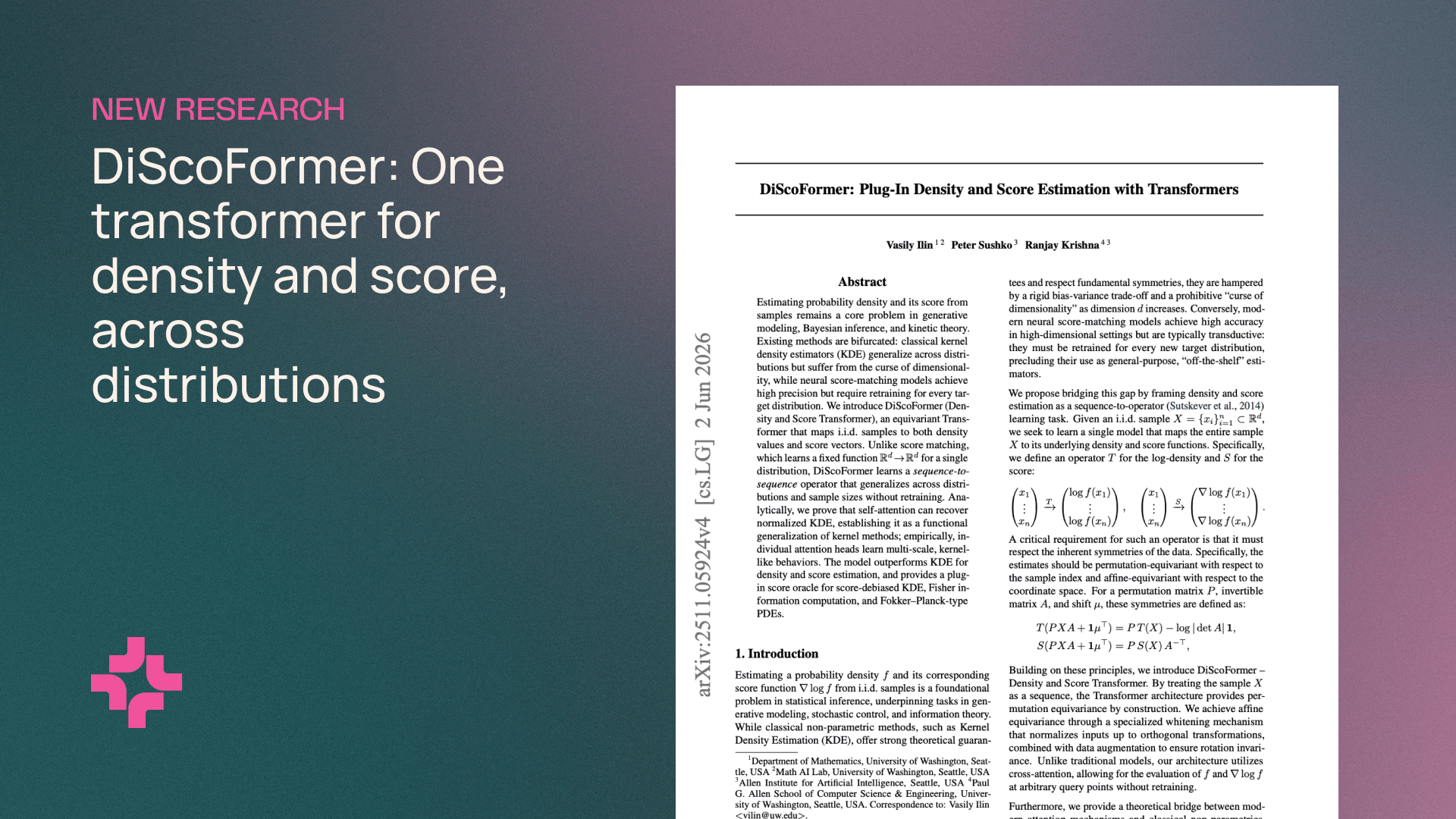
The landscape of artificial intelligence is continuously reshaped by innovations that push the boundaries of what machines can create and understand. At the forefront of this revolution are generative AI models, capable of producing astonishingly realistic images, text, audio, and more. However, building these powerful models often involves complex architectures and specialized training for different tasks. Enter DiScoFormer, a potentially game-changing development from Hugging Face, proposing a single transformer architecture capable of estimating both density and score functions across a wide array of data distributions.
Traditionally, two core concepts drive much of modern generative modeling: density estimation and score estimation. Density estimation focuses on learning the explicit probability distribution of data, allowing models to calculate the likelihood of observing particular data points—a crucial capability for tasks like anomaly detection or robust data compression. Score estimation, on the other hand, involves learning the gradient of the log-probability density function (known as the score function). This gradient is fundamental to score-based generative models (SGMs) and diffusion models, which synthesize new data by iteratively denoising samples guided by this learned score.
DiScoFormer introduces a novel paradigm by unifying these two critical functions within a single transformer model. This means that instead of developing, training, and deploying separate models for understanding data distributions (density) and generating new data (score), researchers and engineers can leverage one cohesive architecture. The 'across distributions' aspect further emphasizes its versatility, suggesting DiScoFormer is designed to generalize effectively across various data types and complexities without requiring substantial architectural modifications or extensive retraining for each new domain.
Key Highlights and Features of DiScoFormer:
- Unified Architecture: DiScoFormer consolidates the complex tasks of density and score estimation into a single, efficient transformer model, reducing model complexity and resource requirements.
- Dual-Functionality: It simultaneously provides capabilities for explicit likelihood computation (density estimation) and gradient-based sampling (score estimation), offering a comprehensive tool for generative AI.
- Generative Versatility: By mastering both density and score, DiScoFormer can enhance existing diffusion models, improve data compression, and offer new avenues for diverse generative tasks across various modalities.
- Distribution Agnostic: The model is engineered to operate effectively 'across distributions,' signifying its robust generalization capabilities to different types of data without specialized fine-tuning for each.
- Simplified Development: A unified approach simplifies the research and development pipeline for generative AI, making it easier to prototype, train, and deploy advanced models.
Why This Matters: Impact and Implications
The implications of DiScoFormer's unified approach are profound. For researchers, it offers a more elegant and efficient framework for exploring the fundamental mechanics of data generation and distribution. The ability to perform both density and score estimation with one model could accelerate discovery in areas like causal inference, out-of-distribution detection, and the development of more robust AI agents.
For practical applications, DiScoFormer could significantly streamline the development and deployment of generative AI systems. Imagine a future where a single foundational model can be adapted to not only generate highly realistic images but also detect subtle anomalies in medical scans, compress large datasets with higher fidelity, or even craft more nuanced and context-aware text. This unification promises greater efficiency, potentially reducing computational costs and environmental impact associated with training and maintaining multiple specialized models.
Furthermore, by providing explicit likelihoods, DiScoFormer could make generative models more interpretable and controllable. Understanding why a model generates certain outputs or how likely a given input is, can be crucial for building trust and ensuring ethical deployment in sensitive applications.
Conclusion and Future Impact
DiScoFormer represents a significant conceptual leap in generative AI. By merging the previously distinct capabilities of density and score estimation into a singular, adaptable transformer architecture, it paves the way for a new generation of more efficient, versatile, and powerful AI models. As AI continues to integrate deeper into various industries, innovations like DiScoFormer will be crucial for unlocking greater potential, simplifying complex development workflows, and driving us toward a future where AI's creative and analytical prowess is more accessible and impactful than ever before. The future of unified generative AI looks exceptionally promising.