OpenAI Codex on ChatGPT Mobile: Revolutionizing Remote Coding
Quick Summary
- OpenAI's powerful Codex AI is now accessible through the ChatGPT mobile app, transforming how developers interact with code.
- This integration enables real-time monitoring, steering, and approval of coding tasks, empowering unprecedented flexibility for remote development across various devices and environments.
OpenAI Codex on ChatGPT Mobile: Revolutionizing Remote Coding
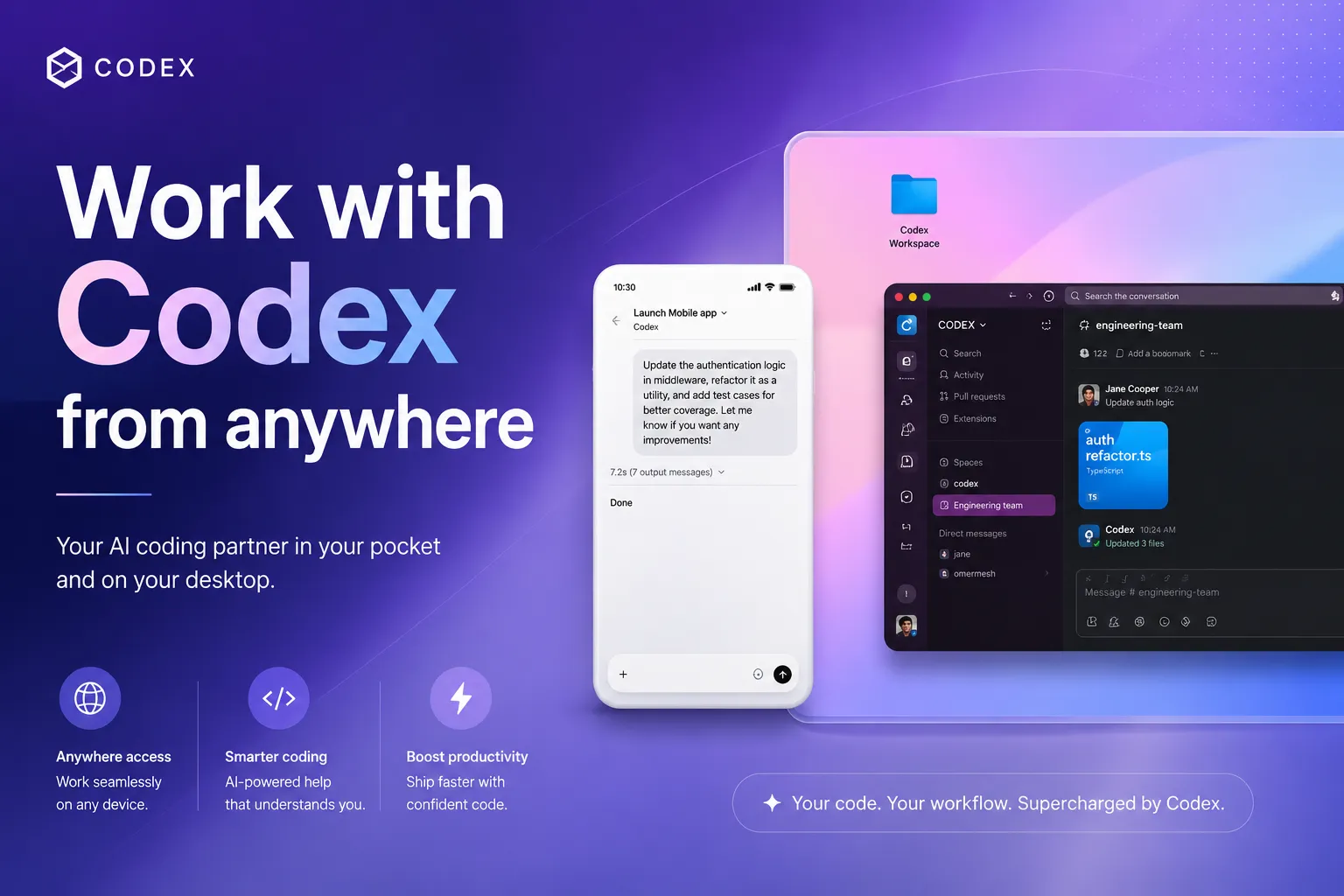
In an era where technology constantly redefines the boundaries of work, the latest announcement from OpenAI marks a significant leap forward for software development. The integration of OpenAI's powerful Codex AI, the engine behind advanced code generation, into the ChatGPT mobile application is set to fundamentally change how developers approach coding tasks, offering unparalleled flexibility and real-time control from virtually anywhere.
The Evolution of Coding: Codex Goes Mobile
Traditionally, complex coding tasks have been tethered to desktop environments, demanding powerful machines and intricate IDE setups. OpenAI's new update shatters this paradigm by bringing the intelligence of Codex to the palm of every developer's hand via the ubiquitous ChatGPT mobile app. This isn't just about viewing code on a smaller screen; it's about enabling a seamless, interactive coding experience that leverages AI to augment human capabilities on the go. Developers can now initiate, monitor, steer, and approve sophisticated coding tasks in real-time, whether they are across town or across the globe. This integration represents a powerful fusion of natural language processing and code generation, accessible anytime, anywhere, on any device capable of running the ChatGPT mobile application.
Key Highlights & Features
This groundbreaking update introduces a suite of features designed to enhance developer productivity and flexibility:
- Ubiquitous Access: Leverage Codex's code generation, debugging, and explanation capabilities directly from your smartphone or tablet. This frees developers from the desk, enabling code-related tasks during commutes, meetings, or field visits.
- Real-time Monitoring & Steering: Keep a live pulse on ongoing coding tasks initiated by Codex. Developers can observe the AI's progress, provide immediate feedback, and refine parameters to guide the code generation process effectively, ensuring the output aligns perfectly with project requirements.
- Secure Remote Approvals: Critical to maintaining code quality and integrity, the mobile app allows for instant approval or rejection of AI-generated code snippets or entire modules. This streamlines the review process, accelerating development cycles without compromising oversight.
- Cross-device Synchronization: Work initiated on a desktop can be seamlessly monitored and managed on a mobile device, and vice-versa. This ensures a fluid workflow, eliminating context-switching friction and maximizing continuity across different work environments.
- Enhanced Productivity: By offloading repetitive or boilerplate code generation to AI and facilitating quick, informed decisions remotely, developers can focus on higher-level architectural design and complex problem-solving.
Why This Matters: Impact Analysis
The ability to interact with an AI coding assistant like Codex via a mobile app holds profound implications for the software development landscape:
- Democratizing Development: Lowering the barrier to entry for aspiring developers who might not always have access to a full desktop setup, fostering a more inclusive coding community.
- Accelerating Agile Workflows: Teams can respond to issues and implement solutions more rapidly. A bug report can be addressed with an AI-generated fix, reviewed, and approved by a developer on their phone, drastically reducing downtime.
- Empowering Remote Work: This innovation solidifies the feasibility of truly flexible and decentralized development teams. Project managers and lead developers can maintain oversight and contribute even when away from their primary workstations.
- Bridging the Gap Between Ideas and Code: For innovators, the path from a conceptual idea to a functional code snippet becomes significantly shorter. Quick prototypes and proof-of-concepts can be generated with minimal setup, fostering rapid experimentation.
- Future of On-the-Go Solutions: Imagine field engineers making immediate code adjustments based on live data, or architects sketching out complex logic during a meeting, with Codex instantly translating those ideas into runnable code. This heralds a new era of responsive, context-aware development.
Conclusion and Future Impact
OpenAI's decision to bring Codex to the ChatGPT mobile app is more than just a convenience; it's a strategic move that redefines the developer's workstation. It transforms the mobile device from a mere communication tool into a powerful extension of a developer's integrated development environment, augmented by AI. This paves the way for a future where coding is less about being confined to a specific location and more about the seamless interaction between human creativity and artificial intelligence, fostering unprecedented levels of productivity and innovation. As AI continues to evolve, we can anticipate even deeper integrations and more sophisticated mobile-first development experiences, further blurring the lines between concept, code, and deployment, ultimately empowering developers to build the future, one line of code at a time, from anywhere imaginable.