AI Models Fail Critical Enterprise IT Benchmark: The ITBench-AA Reveals Frontier Limitations
Quick Summary
- A groundbreaking new benchmark, ITBench-AA, reveals that even advanced frontier AI models score below 50% on complex agentic enterprise IT tasks.
- Developed by Artificial Analysis and IBM, this first-of-its-kind assessment highlights significant gaps in current AI capabilities for autonomous IT operations.
AI Models Struggle on New Enterprise IT Benchmark: The ITBench-AA Reveals Frontier Limitations
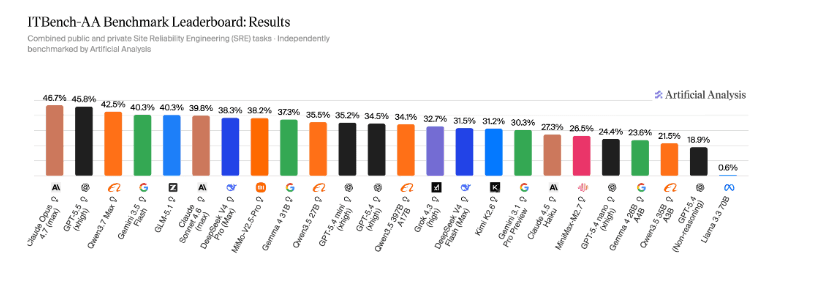
The promise of artificial intelligence revolutionizing enterprise IT operations is vast, envisioning a future where autonomous AI agents seamlessly manage complex systems, troubleshoot issues, and optimize infrastructure. However, a stark reality check has emerged from a pioneering new benchmark: ITBench-AA. Developed collaboratively by Artificial Analysis and IBM, this first-of-its-kind evaluation reveals that even the most advanced "frontier" AI models are struggling, scoring below 50% on essential agentic enterprise IT tasks, underscoring a significant gap between current capabilities and ambitious industry aspirations.
Unveiling the ITBench-AA: A Deep Dive into Agentic IT Capabilities
The ITBench-AA benchmark stands as a crucial milestone in assessing the true potential of AI in enterprise IT. Unlike previous evaluations that often focused on isolated tasks or theoretical knowledge, ITBench-AA is specifically designed to test agentic capabilities within realistic enterprise environments. This means it evaluates an AI model's ability to not just understand a problem, but to plan a sequence of actions, execute those actions, adapt to unforeseen circumstances, and correct errors—all within the complex, dynamic landscape of corporate IT. The benchmark covers a spectrum of practical scenarios, from diagnosing network outages and configuring servers to managing security incidents and optimizing cloud resources. The key finding is sobering: state-of-the-art AI models, often referred to as "frontier models" due to their advanced size and capabilities, achieved scores under 50%. This performance indicates that while these models possess impressive language understanding and reasoning, they currently lack the robust multi-step planning, execution reliability, and deep domain-specific knowledge required for autonomous operation in demanding enterprise IT settings.
Key Highlights and Features of ITBench-AA:
- First-Ever Agentic IT Benchmark: ITBench-AA is the inaugural benchmark specifically tailored to evaluate AI models on agentic capabilities within realistic enterprise IT environments, moving beyond theoretical knowledge to practical, multi-step problem-solving.
- Focus on Real-World Enterprise Scenarios: The benchmark incorporates a diverse range of complex IT tasks, including system configuration, network troubleshooting, security analysis, and resource management, reflecting the intricate challenges faced by IT professionals daily.
- Assessment of "Agentic" Capabilities: It scrutinizes an AI's ability to autonomously plan, execute, monitor, and adapt to feedback in IT operations, rather than merely answering questions or performing single-step commands.
- Sub-50% Scores for Frontier Models: The most advanced AI models currently available demonstrated significant limitations, consistently scoring below the 50% threshold, highlighting a substantial gap in their ability to perform complex, autonomous IT tasks reliably.
- Collaborative Development: The benchmark is the result of a joint effort between Artificial Analysis, a firm specializing in AI performance evaluation, and IBM, a global leader in enterprise technology and AI research, lending significant credibility and domain expertise to the assessment.
Why This Matters: Impact Analysis for Enterprise AI
The results of ITBench-AA carry profound implications for the future of AI in enterprise IT. Firstly, they serve as a critical reality check, tempering the hype surrounding autonomous AI agents and emphasizing the need for more targeted research and development. It's not enough for AI to simply "understand" IT concepts; it must reliably act upon them in an environment where errors can have severe operational and financial consequences. Secondly, this benchmark provides a clear roadmap for AI developers, highlighting specific areas where current models fall short—namely, robust planning, error recovery, and deep contextual understanding of enterprise-specific nuances. For businesses eager to leverage AI for IT automation, these findings suggest that a fully autonomous "lights-out" IT department powered by general-purpose AI is still a distant goal. Instead, the focus should remain on AI as an augmentation tool, assisting human IT professionals rather than fully replacing them, at least in the short to medium term. The benchmark underscores the complexity of enterprise IT, where a myriad of legacy systems, bespoke configurations, and constantly evolving threats demand an adaptive intelligence that current frontier models have yet to master.
Conclusion: Paving the Way for More Capable AI in IT
The ITBench-AA benchmark, while revealing current limitations, is not a testament to AI's failure but rather a crucial step forward in its evolution for enterprise IT. By objectively measuring performance against real-world demands, Artificial Analysis and IBM have provided a foundational tool for guiding future AI development. The path forward will likely involve developing more specialized AI architectures, training models on vast datasets of real-world IT operational data, and integrating advanced reasoning and symbolic planning capabilities. Future AI agents for IT will need to be equipped with a deeper understanding of cause-and-effect in complex systems, better tools for self-correction, and improved methods for continuous learning from operational feedback. This benchmark sets a new standard, challenging researchers and developers to build truly intelligent, reliable, and agentic AI systems that can eventually fulfill the transformative promise of autonomous enterprise IT.